Planning a community swap: venue, sorting and what to do with leftovers
 Save
A swap event lets people exchange clothes, books, toys and household items without spending money or generating waste. Ecomojo walks through the decisions that make one run smoothly, from booking a space to clearing what remains at the end. By the time you finish reading, you will have a checklist that covers the practical side of organising a swap.
Choosing a venue that suits the scale
The right space depends on how many people you expect and what they will bring. A living room works for a clothes swap among friends. A community centre, church hall or school gym suits a neighbourhood event where dozens of people might turn up.
Check the venue allows trestle tables or folding rails — you need surfaces to display items — and that the room has enough light to see colours and fabric condition clearly. Access matters too: a ground-floor entrance makes it easier for people carrying bags, and parking or a bus route nearby removes one barrier to taking part.
Ask about insurance and whether the venue requires public liability cover for your event. Some halls include it in the hire fee; others expect you to arrange your own.
Setting entry rules and what people can bring
Decide whether each person swaps item for item, or whether anyone can take what they need regardless of what they brought. A token system — one token per item brought, one token spent per item taken — keeps things roughly balanced and stops a few people emptying the rails early on. An open swap removes friction but risks disappointing latecomers.
State what condition items must be in: clean, undamaged, and with working zips or buttons. Ban anything stained, torn or missing essential parts. Set a category if the swap has a theme — clothes only, children's items, books and media — so people know what to expect and what to leave at home.
How to handle items that do not meet the standard
Someone will bring things that should not be swapped. Have a separate bag or box ready and hand rejected items back politely as people arrive, explaining the reason once. When rejection feels awkward, frame the standard as fairness to everyone swapping rather than criticism of the item itself.
Sorting zones that make browsing easier
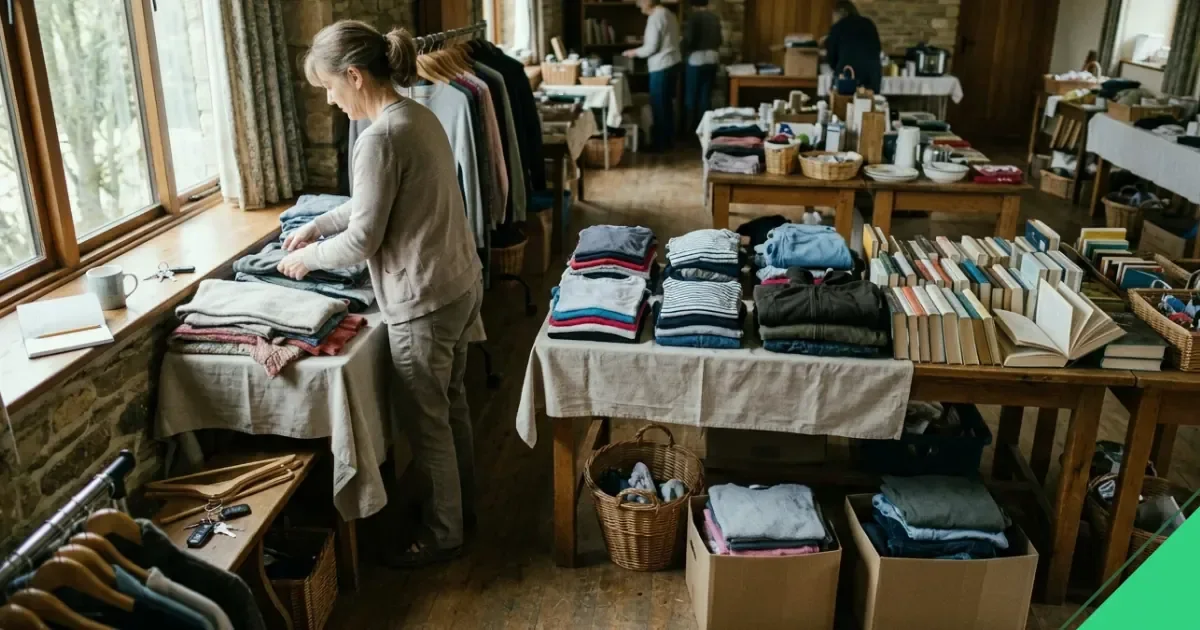
Group items by type or size so people can find what they need without sifting through everything. For a clothes swap, separate tables or rails for tops, trousers, dresses, outerwear and accessories speed up browsing. Within each zone, arrange by size if you have enough space and enough items to make it worthwhile.
Label each zone clearly with signs people can read from across the room. When the swap includes children's clothes, split by age range — babies, toddlers, school age — because parents know those boundaries better than garment measurements.
Keep a table near the entrance for people to drop off items as they arrive, and station a volunteer there to do a quick condition check and hand out tokens if you are using them. This table should not double as a browsing zone, or the queue to drop off will block people trying to look.
Running the event on the day
- Set up tables and rails an hour before the advertised start time, and put signs up outside the venue so people walking past know what is happening.
- Open the doors to people dropping off items half an hour early, then give yourself a buffer to finish sorting before swapping begins.
- Let everyone in at once when swapping opens, or stagger entry in small groups if the space is tight — a stampede tips piles over and makes quieter people step back.
- Walk around during the event to tidy knocked-over stacks and move items that have drifted between zones.
- Fifteen minutes before the end, announce that swapping will close soon so people can make final decisions without rushing at the last moment.
Dealing with leftovers after the swap ends
Unclaimed items are the single biggest question people ask when planning a swap event. Decide the plan before the day and tell everyone as they arrive: leftovers go to charity, back to the person who brought them, or to a specific reuse project you have already contacted.
Charity shops will take clean, good-quality clothes, books, toys and homewares, but phone ahead to check they have space and to confirm drop-off times. Some shops close donations during busy periods or when their stockroom is full.
Textile recycling banks accept worn or damaged fabric that a charity shop would refuse, as long as the material is dry and not contaminated with oil or paint. These banks send textiles for reprocessing into insulation, industrial rags or filling, so items stay out of landfill even when they cannot be worn again. What to do with old bedding covers where to find textile banks and what they take.
Ask people to take their own items back if nothing else is possible, but make that clear in your publicity so nobody feels ambushed. Most people would rather know in advance than be handed a bag of unsold jumpers as they leave.
Community groups that might take specific items
Scout groups, drama societies, nurseries and refugee support organisations often need clothes, fabric and household items. Contact them a week before your swap with a list of what you expect to have left, and arrange a collection time. This gives them a chance to check storage and to say no if they are already overstocked, which saves you a wasted trip.
Publicising the swap without overpromising
Word of mouth through community noticeboards, local social media groups and flyers in cafés or libraries brings people in. State the date, time, location, what items the swap covers and whether people need to bring something to take something away. If you are using tokens, explain the system in one sentence.
Avoid calling it "free shopping" — a swap asks people to give as well as take, and framing it as shopping sets the wrong expectation. "Clothes swap", "swishing event" or "bring and take" describe the idea more honestly.
Set a realistic capacity based on the venue size and how many volunteers you have to help with sorting and door duties. A small first event that runs smoothly does more for future turnout than an overcrowded one where half the people left frustrated.
Costs and whether to charge entry
Hiring a hall, printing signs and providing bags for people to carry items home all cost something. Some organisers charge a small entry fee to cover these expenses; others ask for donations on the day or run the swap at a loss as a community service.
If you do charge, make the amount low enough that it does not exclude people on tight budgets — the point of a swap is to make reuse accessible. A fee that covers the hall hire split across expected attendees usually lands somewhere reasonable.
When money is tight, ask local businesses to sponsor the event in exchange for a mention on your publicity, or approach the council about free or subsidised use of a community space. Some venues waive hire fees for events that serve a social or environmental purpose.
Building on the first event
After your first swap, ask a few attendees what worked and what felt chaotic. Common answers — not enough space to move, unclear sorting, long queues at the entrance — point to the adjustments that will make the next one better.
Keeping a simple record of how many people attended, how many items were swapped and how much went to charity or recycling helps when you apply for funding or support from local organisations later. You do not need a formal report; a notebook with rough counts is enough.
Regular swaps build momentum. People start saving items for the next event rather than throwing them out, and word spreads as attendees tell friends. A swap every season or twice a year gives people a reliable way to refresh what they own without buying new. Package-free shopping on a budget explores other ways to reduce waste while keeping costs down.
#Secondhand #Donation #Reusable containers
Download PDF: Community swap event planning checklist PDF, 29 KB
Further reading
Frequently asked questions
How many items should I bring to a clothes swap?
Bring as many clean, good-condition items as you want to swap. If the event uses a token system, you will receive one token per item brought, which you then spend on items you take away. If it is an open swap, there may be no limit, but bringing a reasonable number leaves more choice for others.
What happens to clothes that nobody takes at a swap event?
Leftovers usually go to a charity shop, textile recycling bank or a community group the organiser has contacted in advance. Some swaps ask people to take their own unsold items back. The organiser should tell you the plan when you arrive.
Can I organise a swap event if I have never done one before?
Yes. Start with a small group of friends or neighbours in a living room or garden to test the idea, then scale up to a hall if demand grows. The core steps — sorting, setting a condition standard, and planning what to do with leftovers — stay the same whatever the size.